Typical terms from the world of junk journaling explained
If you are new to junk journaling, you will probably encounter terms that leave you a bit puzzled. Don't worry, we all felt that way at the beginning. With this article, I would like to shed some light on the jungle of junk journal terms.
Belly Band
A belly band is a firm strip of paper or fabric that is glued or sewn into the journal at its two outer ends either vertically or horizontally. Behind it, you can wonderfully store journaling cards or simply beautiful papers.
You can create a belly band from a simple piece of scrapbooking paper or combine different layers and textures, e.g., by gluing a beautiful lace ribbon with a vintage button onto the paper.
A belly band thus serves as an interactive design element, but also has a practical use for storing additional journaling pages.
Ephemera
Probably one of the most common terms you will encounter in junk journaling. Essentially, it refers to all the small and large pieces of paper that you can use to embellish your junk journal. This includes, for example, tickets, photos, playing cards, or envelopes, i.e., original materials that you collect in your daily life. You also have the option to buy ephemera, for example, in the form of paper sets or sticker books. Or you can make them yourself, like pockets or fictional postcards. The term ephemera is therefore quite comprehensive and can sometimes be a bit hard to grasp.
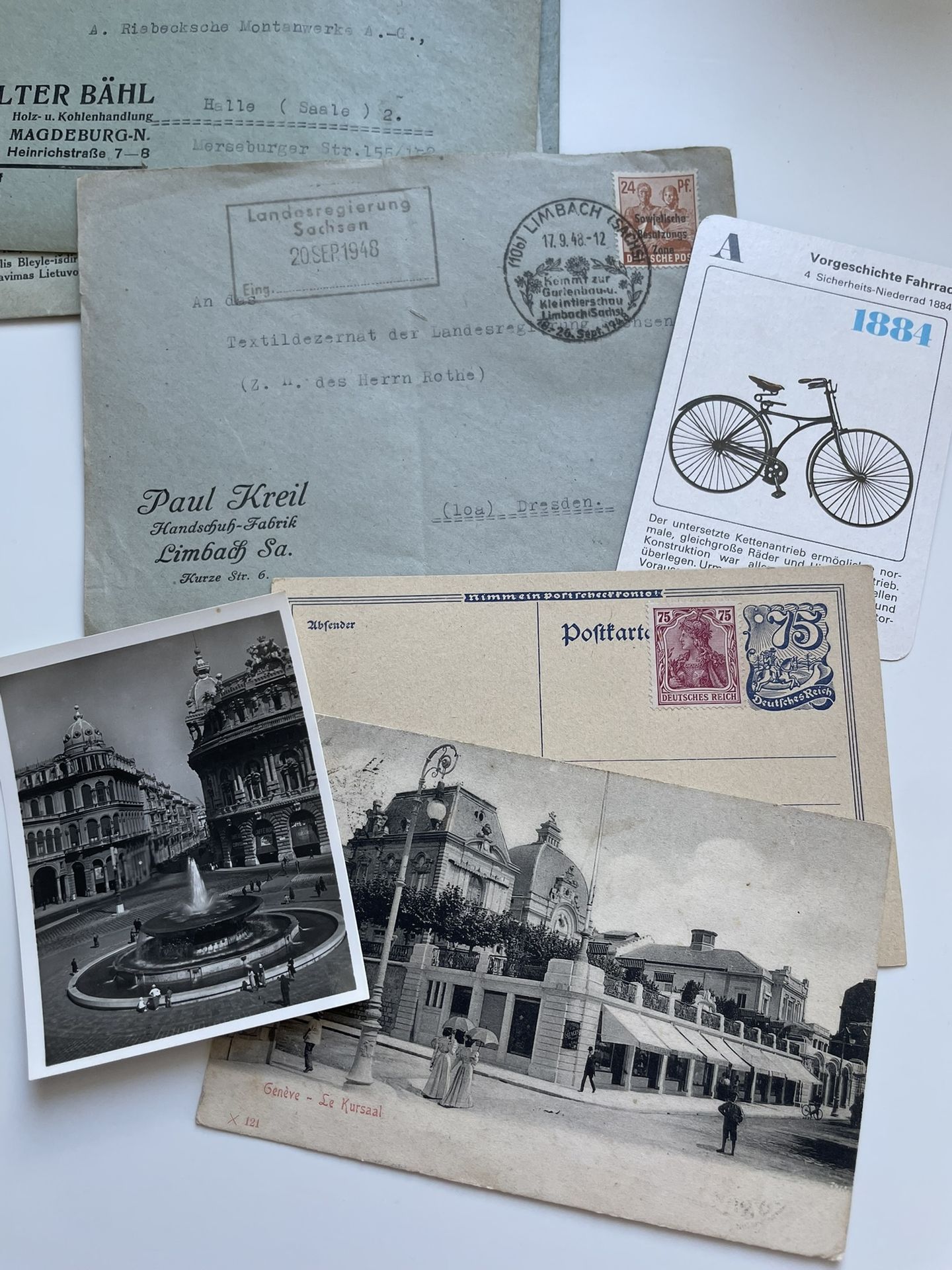
Journaling Card
The German term Journaling card is often used for this. Okay, to be honest, it should be called a diary or writing card, but I haven't heard that anywhere.
Essentially, a Journaling Card consists of a sturdy, beautifully designed front and a solid-coloured, subtle back that provides space for writing. It can be nearly as large as your journal, but typical formats are DIN A6 or DIN A7. You can design it from scratch or use, for example, an unused postcard that you like the design of. If the postcard is already written on, you can easily upcycle it by gluing a light, not too heavily patterned paper on the back. And just like that, you have an interactive element in your journal and additional writing space.
This term is probably the easiest to understand: it is a pocket. Junk journals thrive on interactive elements, and they need to be stored somewhere.
The simplest form is a square of sturdy paper that you glue to 2-3 sides of your journal. Be sure to apply the glue as thinly as possible so that you lose as little space as possible inside the pocket. Where you leave the opening is up to you: left, right, top, bottom - anything is possible. You can glue the pocket in the middle of your page or in a journal corner.
If you find this variant too simple, you will find further suggestions for various designs of pockets for your journal in the video.
Signature
A signature consists of several sheets of paper folded in the middle, usually 8-12 sheets, depending on the paper thickness and the intended use of the journal. If you plan to glue in many collages and pockets, fewer sheets per signature are recommended. However, if you mainly want to use your journal for writing, it can also have more pages. For example, 12 sheets of paper result in 24 pages or 48 front and back sides.
The bundled sheets of paper (signature) are usually sewn by hand into the book cover, often referred to as the cover. A junk journal typically consists of 1-5 signatures.
Tag
You probably know the typical shape of tags for luggage: they are rectangular, but the two upper corners are evenly cut off, and they have a small hole at the top through which a ribbon is threaded for attachment to the luggage. This is the classic tag shape that we also use in junk journaling. What for are you asking yourself? To complement your journal with another playful element and to create a bit more writing space. Sure, it doesn't fit that much text on it - although you can of course also create tags in journal size - but it offers the ideal space for, for example, a quote you want to remember, or for a special photo. You have all the possibilities in the design again.
My hand-bound junk journals are usually equipped with few of these elements, so you can express your creativity as freely as possible and make it your very own personal journal.
Why not stop by the shop? Junk Journals